
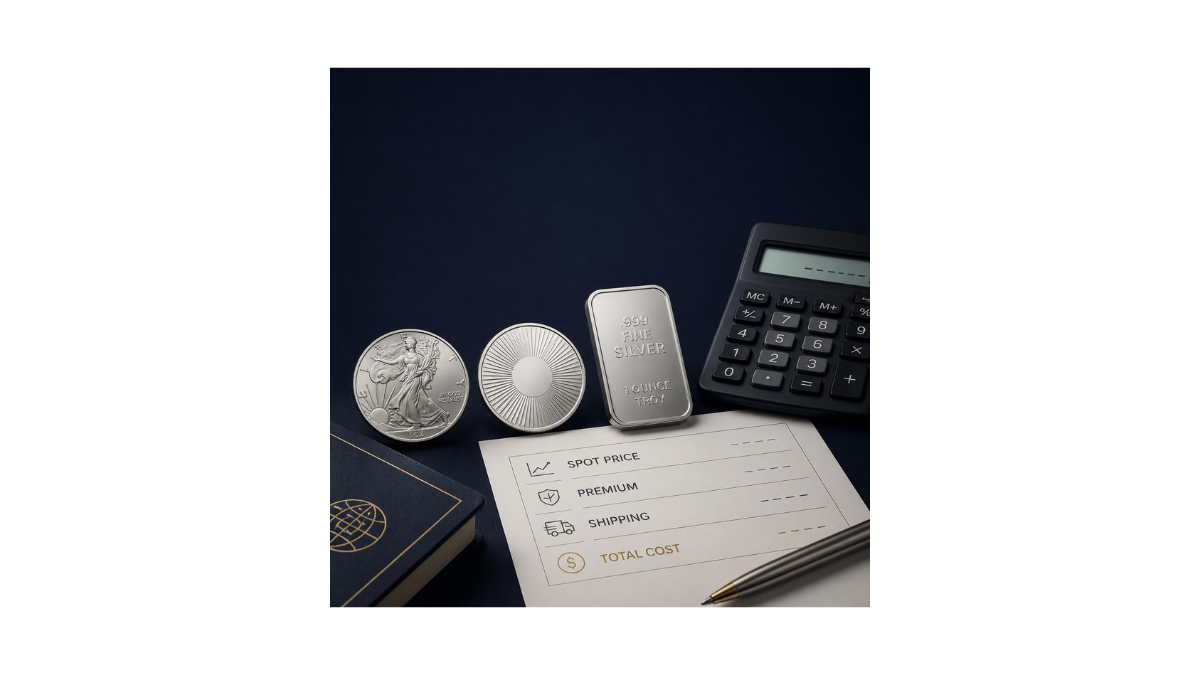
If you are comparing physical silver prices, one question matters more than almost any other:
How Much Over Spot Should You Pay for Silver?
Quick answer: There is no single premium over spot that is always reasonable. A fair premium depends on the type of silver, product size, mint, dealer, payment method, availability and current physical demand.
Instead of looking for one universal percentage, beginners should compare the same product across several reputable dealers and calculate the total delivered price per ounce. That includes the product price, shipping, insurance, payment fees and applicable taxes.
A silver product may have a low advertised premium but still be the more expensive purchase after checkout costs are included.
Important: This article is for educational purposes only and is not financial advice. Silver prices, premiums, taxes, shipping charges and dealer buyback offers can change. Always compare current prices and consider your own financial circumstances before buying precious metals.
What Does “Over Spot” Mean?
The silver spot price is a market reference price, usually quoted for one troy ounce of silver. It is not normally the final retail price of a finished silver coin, round or bar.
When you buy physical silver, the dealer usually charges more than spot. The amount above spot is called the premium.
The premium may help cover:
- Refining and minting
- Fabrication and packaging
- Wholesale distribution
- Dealer operating costs and profit margin
- Secure handling and storage
- Payment-processing costs
- Product demand and availability
- Government-mint or private-mint recognition
For a complete introduction to these two prices, read our guide to silver spot price vs premium.
How to Calculate a Silver Premium
You can calculate a silver premium in dollars or as a percentage.
Premium in Dollars
Product price per ounce − silver spot price = premium per ounce
Imagine that the silver spot price is $50 per ounce and a one-ounce silver round costs $54.
$54 − $50 = a $4 premium per ounce.
Premium as a Percentage
Premium per ounce ÷ spot price × 100 = premium percentage
Using the same example:
$4 ÷ $50 × 100 = an 8% premium.
This percentage helps you compare offers when the spot price changes. However, it should not be the only number you consider.
Use the Total Delivered Price, Not the Advertised Price
The advertised premium may not represent your real buying cost. Your final comparison should use the amount you would actually pay to receive the silver.
Total delivered cost may include:
- The listed product price
- Shipping
- Insurance or handling
- Credit card or payment-method surcharges
- Minimum-order charges
- Applicable sales taxes
Suppose Dealer A lists a one-ounce round for $54 and Dealer B lists the same round for $53.50.
Dealer B initially appears cheaper. But if Dealer B adds $10 shipping while Dealer A offers free shipping, Dealer A may have the lower final cost.
This is why beginners should compare prices at the checkout stage rather than relying only on the first number displayed on a product page.
How to Calculate the True Price per Ounce
For an order containing several ounces, use this calculation:
Total delivered order cost ÷ total silver ounces = true price per ounce
For example, imagine you buy ten one-ounce rounds:
- Product total: $535
- Shipping and fees: $15
- Total delivered cost: $550
- Total silver content: 10 troy ounces
$550 ÷ 10 = $55 per ounce.
If spot is $50, your true premium is $5 per ounce, not the premium suggested by the product price alone.
What Is a Reasonable Premium Over Spot?
A reasonable silver premium is one that is competitive with current prices for the same or closely comparable product from trustworthy dealers.
There is no permanent premium limit because retail conditions change. Premiums may rise when physical demand increases, dealer inventories become tight, mint production slows or buyers strongly prefer a particular product.
The most useful benchmark is therefore the current market for that exact type of silver.
Simple beginner rule
Compare at least three reputable sellers, use the total delivered price per ounce, and avoid paying substantially more unless you clearly understand what extra benefit you are receiving.
A higher premium may sometimes provide:
- Stronger brand or government-mint recognition
- Better resale demand
- A smaller or more flexible product size
- Improved security features
- Better condition or original mint packaging
- A genuinely collectible feature
However, a high price is not justified merely because a salesperson uses words such as “exclusive,” “rare,” “limited” or “investment grade.”
Typical Premium Pattern by Silver Product
| Silver product | Usual premium pattern | Beginner consideration |
|---|---|---|
| Large silver bars | Often lower per ounce | Efficient for building weight, but less flexible when selling only part of a holding. |
| Small silver bars | Low to moderate | More flexible than large bars, although fabrication costs may increase the premium. |
| Generic silver rounds | Often lower than government coins | Useful for lower-cost one-ounce stacking when produced by a recognized private mint. |
| Government bullion coins | Often higher | Greater recognition may support easier verification and resale. |
| Fractional silver | Often high per ounce | Small pieces are flexible, but production costs are spread across less silver. |
| Proof and collectible coins | Potentially very high | Part of the price may reflect finish, packaging, rarity or collector demand rather than metal value. |
To compare the strengths of different formats, see silver coins vs silver bars and silver rounds vs silver coins.
Why Government Silver Coins Often Cost More
Popular government bullion coins often carry higher premiums than generic rounds or bars.
Products such as American Silver Eagles and Canadian Silver Maple Leafs are widely recognized. Buyers may be willing to pay more for familiarity, official specifications, strong dealer demand and easier resale.
The United States Mint explains that its American Eagle bullion products are official legal-tender coins, although their stated face value is largely symbolic compared with the metal value.
A higher premium does not automatically make a government coin a better investment. It means you should decide whether the additional recognition is worth the extra upfront cost.
Our Silver Eagle vs Maple Leaf comparison examines this question using two well-known bullion coins.
Why the Cheapest Silver Is Not Always the Best Deal
Buying at the lowest possible premium may sound ideal, but an unusually cheap product can come with trade-offs.
- The private mint may be unfamiliar.
- The product may be damaged or difficult to verify.
- The dealer may add fees during checkout.
- The item may attract weaker buyback offers.
- The seller may have poor delivery or customer-service records.
- The product may be a replica, plated item or counterfeit.
A slightly higher price from an established dealer may be worthwhile when it provides clearer product information, insured delivery, transparent policies and better resale recognition.
Before choosing a seller, review our guides to the best silver dealers in 2026 and silver dealer red flags.
Compare Like With Like
A fair dealer comparison requires equivalent products. Do not compare the price of a generic silver round with the price of an American Silver Eagle and conclude that one dealer is automatically overcharging.
Compare the same:
- Product type
- Mint or manufacturer
- Weight
- Purity
- Year, when relevant
- Condition
- Quantity tier
- Payment method
- Packaging
Dealers may show a low “as low as” price that applies only to a large quantity paid for by bank wire. A smaller credit-card order may have a noticeably different price.
Do Not Ignore the Buyback Spread
The premium you pay when buying is only half of the equation. You should also consider what a dealer might pay if you later sell the silver.
The difference between the purchase price and the resale offer is commonly called the spread.
For example, imagine that you purchase a coin for $60 when spot is $50. If a dealer would currently buy that coin for $52, the effective gap between buying and selling is $8.
Silver would need to rise, or the product’s resale premium would need to strengthen, before you recovered that gap.
Recognizable products may sometimes receive stronger offers than obscure products, but no premium is guaranteed to be recovered. Learn more in our guide explaining where to sell silver.
Premium Over Spot vs Melt Value
Spot price and melt value are closely related, but they are not always identical concepts.
Spot price is a broader silver market reference. Melt value estimates the value of the actual silver contained in a particular item.
This distinction matters when buying older coins, sterling silver or products that do not contain exactly one troy ounce of pure silver.
A coin marked as 90% silver should not be compared as though its full weight were pure silver. You first need to understand its actual silver content.
Use our guide to silver melt value before evaluating older coins, sterling items or unusual silver products.
When Is a High Silver Premium a Warning Sign?
A high premium deserves additional investigation when:
- The seller will not clearly state the silver weight or purity.
- The markup is much higher than comparable products elsewhere.
- The dealer refuses to explain why the product costs more.
- The salesperson uses fear or urgency to stop you comparing offers.
- The product is described as rare without verifiable supporting information.
- The buyback policy is vague or unavailable.
- Fees and commissions are hidden until late in the transaction.
- The seller promises guaranteed profits or claims silver cannot lose value.
The Commodity Futures Trading Commission and Federal Trade Commission have warned consumers about precious-metals pitches involving inflated prices, high-pressure sales, exaggerated safety claims and misleading promises.
Paying above spot is normal. Paying an unexplained or hidden markup under pressure is not.
A Seven-Step Silver Price Comparison
- Check the current spot price. Use a recognized market-price source.
- Choose one exact silver product. Record the weight, purity, mint and condition.
- Compare at least three reputable dealers. Use the same quantity and payment method.
- Add every cost. Include shipping, insurance, payment fees and applicable taxes.
- Calculate the total price per ounce. Divide the full order cost by the number of silver ounces.
- Calculate the premium. Subtract spot price from your true price per ounce.
- Consider resale. Check whether the product is recognized and whether the dealer publishes a buyback policy.
Should You Wait for a Lower Premium?
Waiting may make sense when premiums are unusually high across several dealers, inventory is limited or the product you want has become temporarily popular.
However, there is no guarantee that waiting will produce a lower total purchase price. Premiums could fall while the spot price rises, or spot could fall while retail premiums remain elevated.
Beginners may find it easier to make smaller purchases over time rather than trying to identify the perfect day to place one large order.
Do not use emergency savings, borrow money or make a rushed purchase merely because someone predicts an immediate silver shortage or price explosion.
Best Beginner Approach to Silver Premiums
A sensible beginner approach is to prioritize transparency, recognizability and total cost rather than chasing either the cheapest or most impressive-looking product.
- Start with common bullion products.
- Compare the same item across multiple dealers.
- Use total delivered price per ounce.
- Understand why one product carries a higher premium.
- Avoid expensive collectibles until you understand grading and collector demand.
- Check the dealer’s reputation and buyback process.
- Buy gradually while learning the market.
- Plan secure storage before placing a large order.
If you have not bought physical silver before, read how to buy silver online safely before ordering.
Final Verdict: How Much Over Spot Should You Pay?
There is no universal percentage that every beginner should pay over spot. The reasonable premium for a generic silver round will not necessarily be reasonable for a government bullion coin, small bar, fractional product or collectible coin.
The best answer is to establish the current competitive price for the same product and calculate its total delivered premium.
Best beginner rule: Compare at least three reputable dealers, calculate the true price per ounce after all costs, and do not pay substantially more unless you understand exactly what the additional premium provides.
A premium is a normal part of buying physical silver. Confusing pricing, hidden charges, pressure tactics and unexplained markups are reasons to pause.
Frequently Asked Questions
What is a good premium over spot for silver?
A good premium is competitive with current prices for the same type, weight, mint and quantity of silver. Because market conditions change, compare several reputable dealers rather than relying on a permanent percentage.
How do I calculate how much I am paying over spot?
Divide your total delivered cost by the number of silver ounces, then subtract the current spot price. The result is your true premium per ounce.
Is it possible to buy silver at spot price?
Occasional promotions or private sales may be close to spot, but normal retail physical silver usually costs more because of fabrication, distribution, dealer and delivery costs.
Why are Silver Eagles so far over spot?
American Silver Eagles may carry higher premiums because of U.S. Mint issuance, legal-tender status, recognition, demand and resale familiarity. Whether the extra premium is worthwhile depends on the buyer’s goals and available alternatives.
Do I get my silver premium back when I sell?
Not necessarily. Some popular products may receive offers above spot, but resale premiums depend on market demand, product condition, dealer inventory and the buyer. Never assume the full purchase premium will be recovered.
Are silver bars cheaper over spot than coins?
Silver bars often have lower premiums per ounce, particularly in larger sizes. Government coins may cost more because of mint recognition and demand. Compare total delivered prices because the pattern can change.
Should I buy the silver with the lowest premium?
Not automatically. Also consider authenticity, mint recognition, dealer reliability, product condition, delivery costs and future resale demand.
Related Silver Investing Guides
- Silver Spot Price vs Premium
- Silver Dealer Red Flags
- Silver Melt Value Explained
- Best Silver Dealers in 2026
- How to Buy Silver Online Safely
- Silver Bullion vs Numismatic Coins
- Where to Sell Silver
External References
- Commodity Futures Trading Commission: 10 Things to Ask Before Buying Physical Gold, Silver or Other Metals
- Commodity Futures Trading Commission: Precious Metals Fraud Advisory
- Federal Trade Commission: Investment Scams
- United States Mint: Bullion Coin Programs
- London Bullion Market Association: LBMA Silver Price